We are living longer, but many of us are also dying longer. On the Digital Legacy Podcast, I sat down with plastic surgeon and longevity physician Dr. Cory Goldberg to talk about digital twins, and what happens to yours when your physical body is gone.
When a mutual associate introduced me to Dr. Cory Goldberg, the pitch was simple: a longevity doctor who is talking about digital twins. What I got was one of the most fascinating conversations I have had on the show, one that sits exactly where my work lives, at the intersection of how we live and how we prepare to die.
Cory is a plastic surgeon by training, practicing in Toronto, where he leads FORM, a nearly 24,000 square foot longevity and aesthetics center in Midtown. But his path into longevity medicine started with his own health journey, a fifty pound weight loss and a complete change in mentality around 2010. What he noticed in his patients changed his practice: “In managing people’s aesthetic, it was doing much more for them as a whole than just a surface image.”
That led him somewhere the aesthetics industry rarely goes. “Where we start at FORM is the belief that true beauty comes from within,” he told me. “Energy, devices, needles, knives, the treatments, those things are available, but those are the layer that you put upon someone by choice after they’ve achieved health.”
Aging is not a foregone conclusion
The line from our conversation that stopped me was this one: “Aging itself is a disease and it can be modified.”
Cory’s argument is that the industry spent twenty years painting on the appearance of youthfulness while assuming nothing could be done about aging itself. That assumption is collapsing. He believes a child born today has a realistic shot at living to 150, and that the real goal is not lifespan but what he calls health span and beauty span: “It’s not just about lifespan. We want to extend people’s health span, and what I refer to as beauty span. The duration that you’re alive, that you have good health, good vitality, and function.”
Because as I said to him, and as I see every day as a thanatologist: yes, we are living longer, but we are also dying longer. Nobody wants 150 years in poor health. As Cory put it, “Who in the heck wants to live 150 years in bad health? It would be something you would wish on your worst enemy.”
And in the meantime, his practical advice echoes a philosophy you may have heard from the longevity world: “Take care of yourself, don’t die of something stupid. And that way you can take best advantage of these things as they become available.”
I could not help thinking of my own story, which I shared with Cory on the show. I lost my mother when she was just about 51 and I was 21. Standing in hospice, having already lost my father, I asked how I could keep this from happening to me. The hospice social worker calmly told me, “The best way to prevent cancer is to live a happy, healthy life.” At 21 I did not know what that meant. My whole career since has been about figuring it out.
Your digital twin, in life and after it
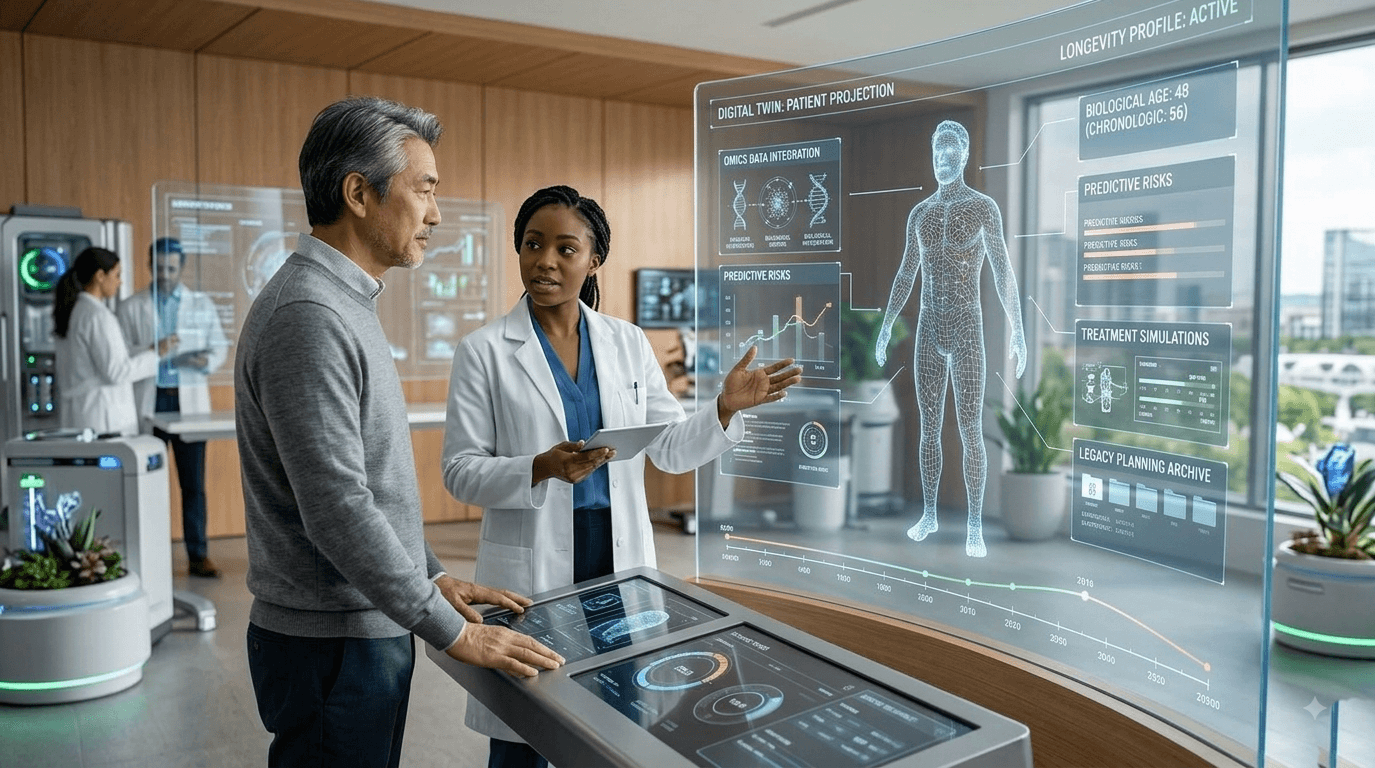
So what is a digital twin? In Cory’s words, “a digital electronic version of you.” Your imaging, your genetics, your physiology, your biomarkers, even your memories, built into an entity that evolves as you do. In health care, it becomes a place to test treatments safely before they ever touch your body, and a window into how you are really doing, organ by organ. FORM is building toward this now, starting with biological clocks on a per organ basis.
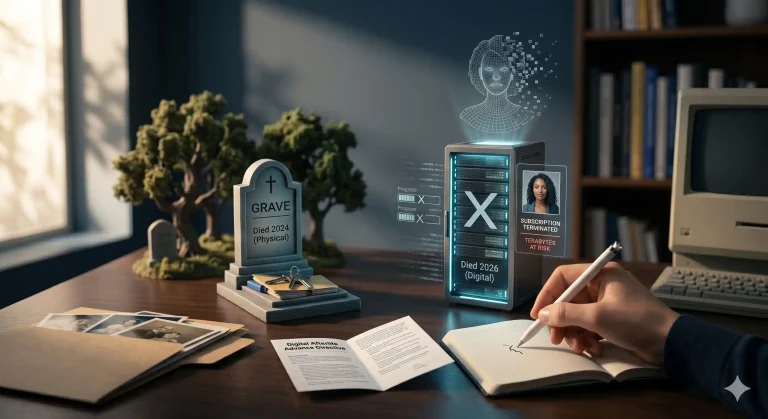
But here is where our two worlds met. I asked Cory the big question: my physical body has an expiration date, whether at 80 or 120. What happens to my digital twin when my physical body is gone?
His answer is why this episode matters. The twin is an asset, a digital thing that must be managed like any other part of your digital estate. Who owns it? Does it have rights that survive your physical death? But it is also something more. “What if you start when you’re a teenager or in your twenties, and you start to create your twin, and you have your entire lifetime to tell it stuff?”
Compare that to how most of us plan today. “A will is a very rudimentary document,” Cory said. “You write that yesterday and a month from now it’s changed, but you don’t have the chance to go change it.” A twin trained over decades, asked one probing question a week about what matters to you and what you want after you pass, becomes a living record of your wishes. Or as Cory put it, with a laugh: “If I could die and know that I’m sitting around and I can tell people what I really want, wow.”
Yes, it is a Black Mirror episode. The ethical questions are real, and we named them. But this is the continuity between life and death that Cory described at the top of our conversation, and it is exactly where legacy readiness is heading.
What struck me most came at the very end. Here is a physician planning to ski at 120, who admitted on air, “I’m not as ready as I would like to be.” Even the people optimizing every biomarker still need their legal, financial, physical, and digital lives buttoned up. Longevity and readiness are not opposites. They are the same practice.
Live Fully ~ Die Ready